On the Way of St Francis
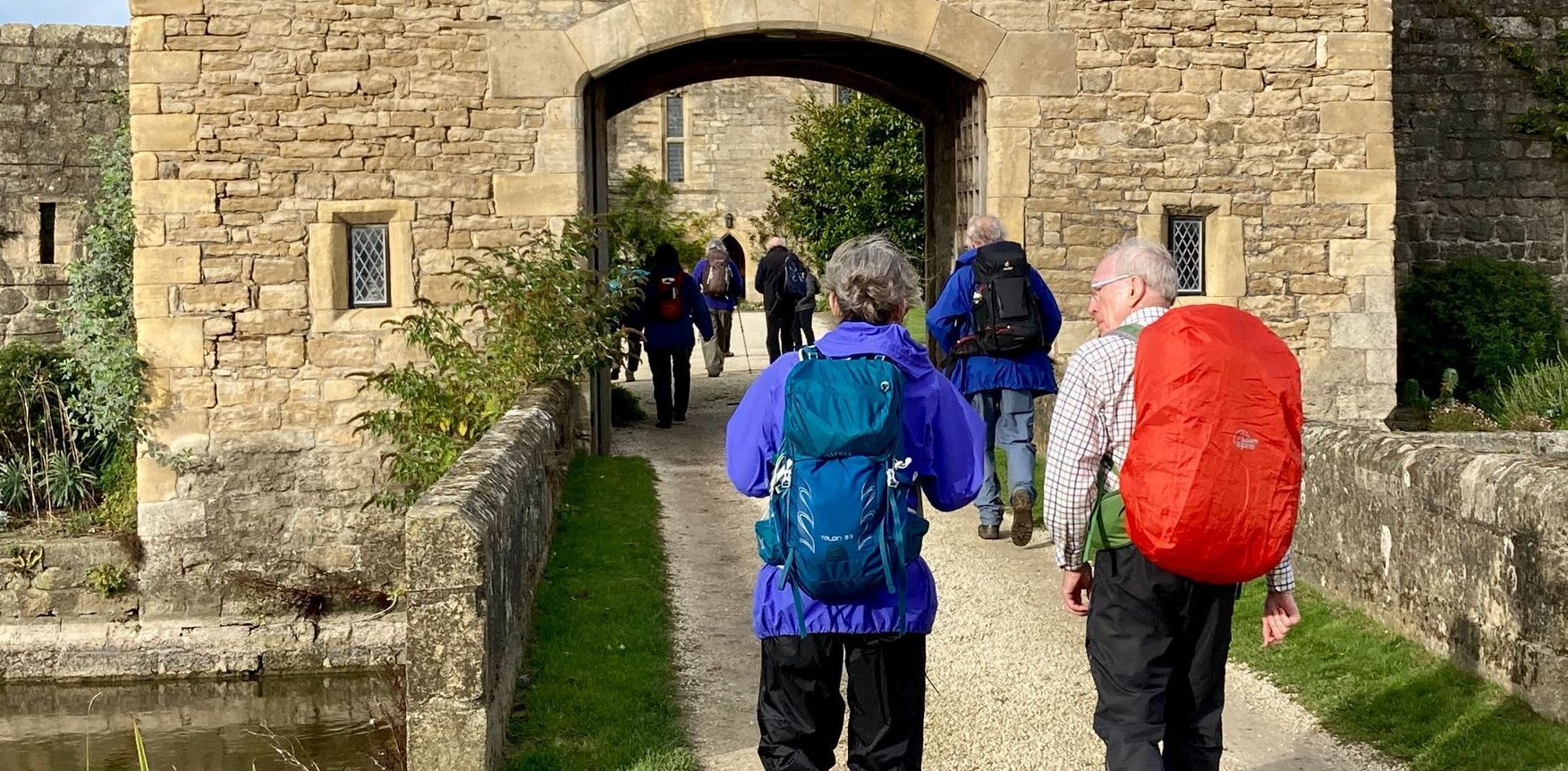
The pilgrimage from La Verna to Assisi and Rome was the last in a series of walks Eddie Gilmore did with his wife, Yim Soon, and being on the Via di Francesco, the Way of Francis, held particular significance for them both.
The Sanctuary of La Verna was built on land gifted by a nobleman to Francis in 1213 on the remote and craggy mountaintop site of Monte Penna. At more than 1,000 metres of altitude, the views over the valleys below and to the Tuscan Appennines all around are truly breathtaking. What struck me equally was the incredible quality of the birdsong in the forested area just above the sanctuary. Very appropriate too in view of the classic image of St Francis (one we have on the wall in our bedroom in fact) apparently communicating with the birds! It was a special place indeed. We went into a couple of the caves where Francis would spend up to forty days in prayer. I couldn’t imagine staying there for even forty minutes, they were so cold and damp! La Verna was also the place where Francis received the stigmata in 1224, and a long corridor of frescoes marks the event.
We were in the basilica at 7.30 a.m. for the nicely sung lauds service with the resident Franciscan community, at the end of which we and the other pilgrims present were given a blessing by one of the friars. If I understood his Italian properly, I think he told us that this would be the most beautiful moment of our lives and he also prayed that we would receive strength when we got tired! Breakfast followed, and then, rucksacks on backs, we were on our way. Almost the wrong way! I nearly led us down the mountain and back towards Florence but an Italian man kindly put us right. I often say to people that getting a bit lost now and again is all part of the pilgrim experience!
To my surprise, in view of how high up we already were, the path ascended steeply for the first kilometre or two. Later on, it descended steeply. And that’s pretty much how it was for those nine days to Assisi; up and down, up and down: in pilgrimage, as it is in life generally! But what treasures we found at the top of those mountains, whether it be attractive fortified towns or remote hermitages. We came to one such hermitage, the Eremo di Cerbaiolo, on the morning of our second day. This site, built onto the side of a steep granite ridge, was gifted to Francis by local priests in 1217 and he installed there a community of friars. Nowadays, it’s tended to by Carlos, a Camaldolese monk, who greeted us when we arrived, huffing and puffing, at the door. With its central cloister, the gentle sound of Gregorian chant being played in the little old church, and the specular views, not to mention the birdsong, the sense of peace and harmony was palpable.
After a week on the trail we came to a hermitage where we got to spend the night and what a night it was. The Eremo di San Pietro in Vignetto no longer has a resident hermit. Rather it is run as a ‘donativo’ pilgrim hostel by the Confraternity of St James. Members of that organisation have walked the Camino to Santiago in Spain and, following an ages old pilgrimage tradition, they come back as hospitaleros, volunteers, to help other pilgrims. We’d arrived at the remote fifteenth century church and attached buildings in the hills to find a group of people finishing lunch at a long table out in the courtyard. Now, one of the things I enjoy doing on pilgrimage is meeting interesting characters from different countries and hearing their story, and another thing I enjoy doing on pilgrimage is eating with them! To my delight, Yim Soon and I were given seats at the table by Sofia, a friendly young Italian woman who then put plates of food in front of us, as well as a generous carafe of white wine (which was frequently replenished). Shortly afterwards there appeared Marius from Berlin who was on the first day of his pilgrimage and who we had met that morning on the path. He was also presented by Sofia with food and wine.
It was a long lunch! Pilgrims came and went but the animated conversation kept going throughout, and in a variety of languages, and there was lots of laughter. The final touch from Sofia was what she called the ‘holy wine!’ It was fortified, like sherry, and it was delicious. Marius retreated to his bed in the dormitory where we would also be sleeping and emerged a couple of hours later to declare with a smile, “It’s only my first day and I’m drunk already!” He didn’t know what was coming later in the day!
The main hospitalero was a larger-than-life character called Luigi who was the father of Sofia. He was fascinated by my Irish/British background and brought me to the kitchen to make me a proper cup of tea made with real tea leaves. He was keen to tell me about his time living in “Swinging London” in the early 70s when, he declared, he used to wear 15cm high platform boots! Later he began to cook for those of us who would be staying the night, and we were invited to help. Before dinner, he led a most touching ceremony in the chapel; a prayerful, intimate space which had on the wall behind the altar the original large fresco. He shared with us how the Camino had changed his life. He had also had an insight that I’ve had too through being a pilgrim, that we can be happy with very little. Then he got down on his knees and washed the feet of each of us in turn. The meal that followed was a true feast. The starter was something that Italians eat on Easter Sunday morning to break the fast of Lent. Describing it as bread with cheese or prosciutto and smothered in olive oil doesn’t really do it justice, it was so tasty. As was the main course which was a spicy minestrone. Dessert was Amaretti biscuits with berries on top and covered in a rich red berry sauce. And, as at lunch, there was a selection of wines, including the ‘holy wine.’ For the final flourish, Luigi produced not just one or two but three bottles of strong content! There was the traditional clear grappa, there was the Amaretto that Yim Soon and I had been given on a previous night by a lovely, friendly woman called Ophelia, and there was one that Luigi proclaimed was the true digestif! It would have been rude to refuse…
Two days after that memorable night at the Eremo di San Pietro we made it to Assisi. Yim Soon had first gone to that striking hilltop town in 1987 when travelling in Europe. Francis is her favourite saint and when she became a Catholic she took the confirmation name of Clare who was a close companion of Francis and who founded the order of Poor Clares. She met in Assisi some people from L’Arche in France who invited her to visit, which she did. She liked it there but didn’t speak French so was sent to the L’Arche community in London, then in 1989 she came to be part of L’Arche in Canterbury, where I had arrived the year before. I met her on her first day!
It was special, then, to be going to Assisi together but, as is often the case for me, the arrival at a pilgrimage destination is rather an anti-climax and I struggle with the tension between being a pilgrim and being a tourist. Assisi was packed with tourists and it was especially busy and noisy because of the Calendimaggio, the four-day May festival, where large numbers of locals dress up in medieval costumes and throw flags around and bang loudly on drums! After the peace and quiet of the path through the mountains I just couldn’t cope with it! What’s more, the centre of the town (and therefore all the restaurants) was temporarily closed off due to the festival. I was hungry and I was stressed and, as the sound of the drums got louder and louder, I had a complete meltdown just outside (of all places!) the Basilica di Santa Chiara, (built on the site of San Giorgio where Clare first heard Francis preach)! I strode away from the noise to an area where there was a line of trees. From the top of one of those trees there came the most beautiful birdsong. I stood for a few seconds and listened and it was so healing. I thought again of St Francis and the birds. Then I went back to Yim Soon and was relieved to see that the streets had been unblocked and we were able to find something to eat. Saved by the birds…
I felt like a new man the next day and it all began with a communal meal. Lovani from Brazil was our lovely hospitalera in the pilgrim hostel, Laudato Si. Like Luigi she had had a profound experience walking the Camino and was coming to Assisi for a month “to give something back.” She had invited us to a simple breakfast in the hospitalera kitchen. Yim Soon and I and Marius were the first ones there with Lovani, plus Italian Paula, an equally lovely woman who had just completed her stint as a hospitalera and would be leaving that day. They had prepared real Italian coffee, with hot milk for those (like me!) who like caffé latte. To go with it there was crispbread and jam and biscuits, and the most delightful conversation in a wonderful hybrid of Italian, German and English. Marius had some great Camino stories. The best was from his time on the Camino del Norte in Spain where he was asked on the forms in the hostels to state his profession and he used to write something different every day! Once he declared himself to be an astronaut! Another time he wrote that he was the mystery son of the famous Italian film director Federico Fellini! I managed to explain in my basic Italian about my struggles the night before but how this simple shared breakfast with its heart-touching fellowship had been a taste of paradise.
Yim Soon and I had an enjoyable day in that special town, which has such a central place in our own story. It included a visit to San Damiano, where Francis heard the crucified Christ telling him to ‘rebuild my house.’ It’s also where Clare established her first community of sisters. It’s a peaceful, prayerful place and I was especially moved in a room dedicated to the Canticle of the Sun which was written by Francis in 1225. It’s a song of praise to all creation, and addressed to ‘Brother sun, Sister moon, Brother wind, Sister water…,’ and I was interested to read how Francis had written it at a very dark period in his life.
After several hours of being part pilgrim/part tourist I needed to go back to our room for a bit of peace and quiet. But this room for our second night in Assisi was overlooking the square of San Giacomo, where preparations were underway (including drumming practice!) for that night’s instalment of the Calendimaggio. In the end I just decided to go with the flow and enjoy that incredible spectacle. And that entailed being woken up at half past midnight by what sounded like an explosion! In that square just below our window, braziers and torches had been lit, drummers were drumming, and there was a vast procession of people in medieval dress dancing towards the cathedral of San Giacomo. And outside the cathedral there was the erection of a gigantic maypole. It was simply amazing.
The remainder of our pilgrimage, which ended in Rome, wasn’t quite as spectacular as that. But there were plenty more special moments and there was lots more warm hospitality. The night after Assisi, the elderly Franciscan sisters at the Convento Piccolo San Damiano gave us a meal and a bed and a breakfast which included Panettone bread which is eaten at Christmas, and which I love. One of the nuns had declared it to be ‘Festa di bambini,’ feast of the children. Marius, who had once lived in Italy, declared to us when we told him about it later that the Italians can make a feast out of anything!
Another warm Franciscan welcome was at the Convento di San Giacomo which is high up in the mountains above the small town of Poggio Bustone. This sanctuary has a little chapel built onto the mountainside. It’s another place where Francis liked to pray and it’s where he had a revelation that all his sins were forgiven, also that his order of friars would grow throughout the world. Highlights there for me were meeting Fra. Renzo and his forty cats (all of whom are named after characters in ‘Lord of the Rings!’) and the meal in the kitchen shared with Marius and two other German pilgrims we got to know on the way: Uli and Tabea, who kindly cooked for us. The views as well down over the valley were, again, utterly breath taking.
It’s not Franciscan as such but I can recommend to any pilgrim a stay at Il Refugio di Noi which is about three days from Rome. It’s the lovely home of a lovely family, Simona and Filippo and their sons, and they open their doors to pilgrims, who are invited to join the family for their evening meal. It was out on the terrace next to a fragrant honeysuckle and besides Yim Soon and I there were a couple of Italian pilgrims (one of whom was especially passionate about football and was teasing the younger son about being a Juventus fan when living close to Rome!), and a Japanese man Taka who had already walked to Rome from Lucca and was walking back to La Verna. There was delicious food (the final course being strawberries in red wine, sprinkled with chocolate, that might even have had the edge on Luigi’s dessert!), there was sparkling conversation, and as well as the wine there was a digestif to, literally, finish us off! Just like at Luigi’s donativo hermitage, it was like a scene from a Camino film. And I was so grateful, and felt so blessed, to be a character in it!
Yes, we can truly be happy with very little. But a good meal shared with interesting fellow-pilgrims helps as well!
Buon Cammino!
Eddie Gilmore is a Hearts in Search of God project collaborator.
For more about Eddie and his books click here.