Walking the Francigena Britannica - with a baby!
Over the last 12 months, Alex Knox walked Britain’s newest pilgrimage with its youngest pilgrim. This is their story, first published in the annual magazine of the Confraternity of Pilgrims to Rome.
At five weeks old, my daughter Stella screamed down the carriage of our packed commuter train en route to London Bridge to begin the Francigena Britannica, the new extension to the Via Francigena from Southwark to Canterbury. It wasn’t auspicious. It was the first time I had taken her alone into London, and as the decibel levels of her crying rose, I paused to reflect that maybe this wasn’t such a good idea.
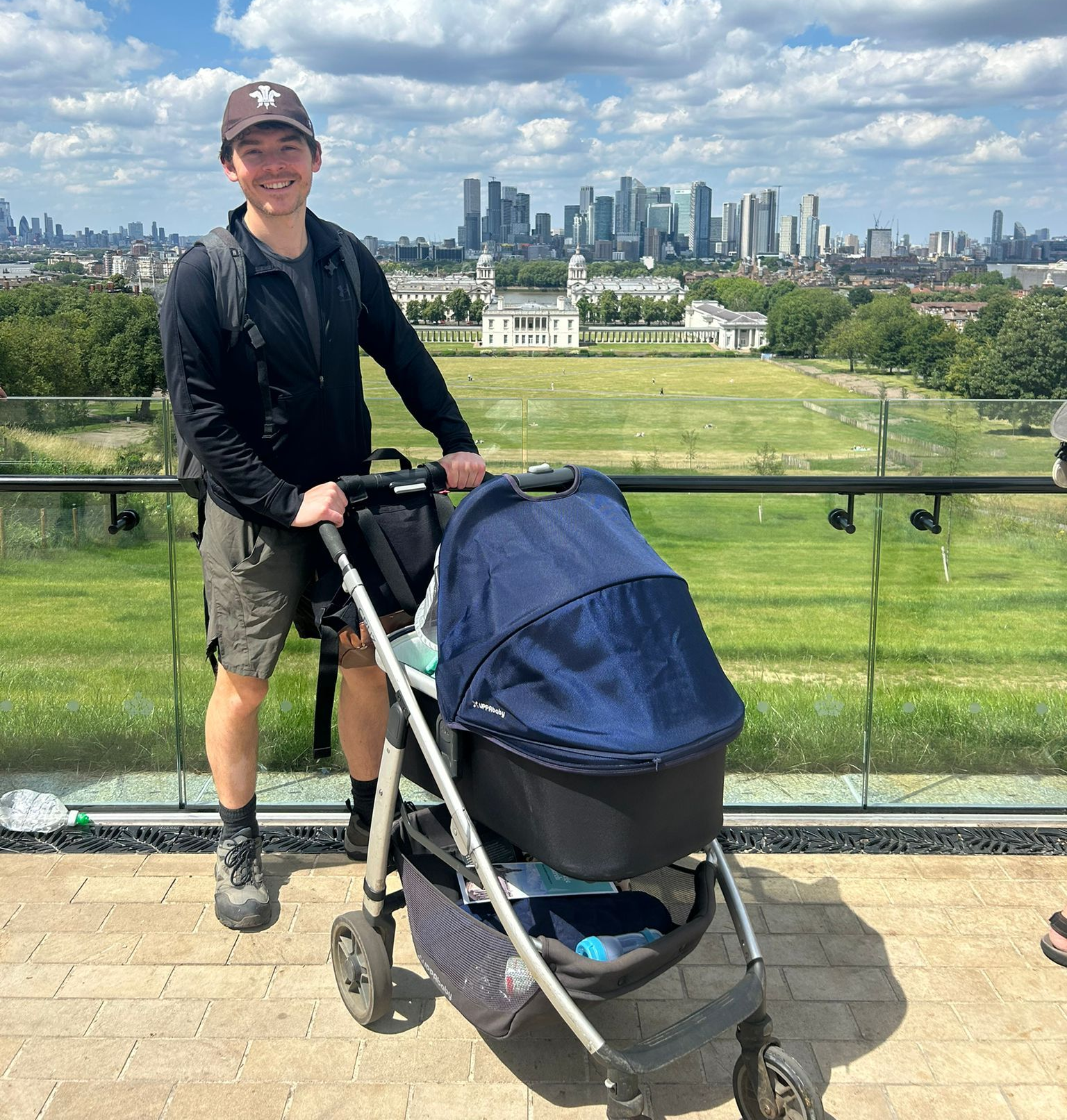
Off the train, however, and having successfully coaxed her back to sleep, I pushed her for two-and-a-half hours in the direction of Canterbury. I was lucky to experience some remarkable stages along the Via Francigena in 2022, but I’m not sure any offered me quite as much satisfaction as that morning stroll along the Thames Path to Greenwich. Still dizzy in the aftermath of becoming a father, the simple of act of walking with her that day - hearing the wheels of her pram skim the paving slabs, to feel my legs stretching for the first time in weeks, to peer intermittently beneath the lid of her pram and see her still dozing on - made me happier than I could have hoped.
Averaging one walk per month, we accrued the miles slowly. After years of trying and failing to slow down while walking, it was travelling with a baby that finally did the trick. I had no choice but to travel at her speed, stopping when hunger and nappy changes dictated, and the result was surprisingly freeing. Sometimes we had to cut the days miles short of the intended destination, but I quickly learnt to be at peace with this. Prior to setting out, I had resigned myself to a sedentary year, accepting that my walking boots would likely see little more than the inside of a cupboard, so each day on the path seemed a bonus to me.
I learnt that it is just about possible to walk the Britannica with a buggy as far as Erith - though Abbey Wood, with its hills and jagged root systems, tripped us up several times. It was only after Stella was happy to be carried, when I could ditch the buggy in favour of the papoose, that we were able to push on beyond London and gain some proper momentum. Stella was five months old when we made it beyond the force field of the M25, and by this stage the game of catching her nap times in order to walk while she slept (a feature of all our early walks) was a thing of the past.
Alert to her surroundings, I could watch her observing the passing countryside as we walked. Before long, I noticed how calm Stella was in this new environment - how little entertainment I needed to provide her with along the way. She was beaming as we approached Shoreham. This was at the end of a day which had passed without even a whimper of protest. I could hardly believe it. I think that was the first moment when Canterbury seemed a realistic goal.
Babies, however, have a way of keeping you in check, and the subsequent stage to Wrotham, in late December, did just that I had trialled Stella in her new Osprey baby-rucksack near home, and the early signs were promising. A mile into the walk, however, still a good way short of Otford, and Stella, now pushing six-and-a half months, suddenly changed her mind on this front. The screams could be heard for miles around. Hastily switching her to the papoose, I managed to quell the worst of her meltdown, but a whole a bag of carrot puffs was required to get us as far as Otford, by which time Stella had a ginger beard to go with her tear-stained face. A shout out here to Sally’s Cake Emporium, whose staff couldn’t have been more helpful. Some warmth, a half an hour stint in a high chair, and a bottle of milk later, and Stella was back to herself. I didn’t dare try her in the rucksack again that day, however, which meant walking with her on my front and the rucksack on my back - not advised: my feet took a battering. Though we made it to Wrotham as planned, there was a sting in the tail during the walk to the railway station. With evening closing in, and the temperature dropping, Stella’s feet, unbeknownst to me, had managed to push free of her winter suit. By the time I had realised, they were red with cold. Aboard the train back to London, I battled with another bout of screaming. The day caused me to lose some confidence in the pilgrimage; it would be another eight weeks before we returned to the path.
It was during this hiatus that my own involvement with the path changed significantly. I found myself part of the Britannica Working Group and subsequently was invited to be its Chair. The path had been unanimously voted into being by the EAVF a couple of months earlier, and was now an official extension of the Via Francigena, so there was a lot of work to do. It meant that my mission to reach Canterbury with Stella was now closely interlinked with a separate endeavour, each of which would steadily enrich the other over the coming months.
I was relieved to find that, by the time we picked up the Britannica again at the end of February, Stella had grown to love the rucksack. I don’t say this lightly. Now eight months old, she was enjoying craning her head around while in the pram, and the opportunity to do this six feet in the air proved a revelation for her. Not only this, but she found she could very happily sleep and eat in the rucksack. She seemed disappointed whenever I motioned to take her out.
As we continued, there was a new practical element to our walk. Stella and I were now ‘ground-truthers’, responsible not only for testing the route but at times trialling proposed sections. On a handful of occasions, we found ourselves walking stretches of the path never tried before, which sometimes resulted in these being incorporated into the main route. We were, at times, actively walking a path into existence. I found this thrilling. Bit by bit, as late winter morphed into spring, we nudged our way along the Britannica, crossing the Medway in March.
The only rule I had imposed on the walk was that we would use only public transport to travel to and from London. The Britannica has excellent train connections, with every stage finishing within easy walking distance of a station, and we took full advantage of this. Naturally, the further we walked into Kent, the longer these train journeys became, to the extent that they proved a defining element of the journey. By April, when Stella was ten months old, she was confidently on the move, and she spent most of these journeys crawling on seats and carriage floors. Whether on trains or on the path, I learnt that you are rarely more approachable than when with a baby. In villages along the route, locals were invariably quick to comment on the rucksack and ask what we were up to. This was a chance to spread the good news about the Britannica. Again and again, I was struck by the wide-eyed reactions from locals when they heard how a single path now connected their village with Rome.
Vineyards, teeming hedgerows, birdsong. May brought with it new colours and scents. Stella seemed alive to the change. Now that she had learnt to point, I could see the path more clearly from her point of view: how trees and animals were most likely to grasp her attention. A passing dog would always spark a little 'duh' sound, the closest thing to her first word.
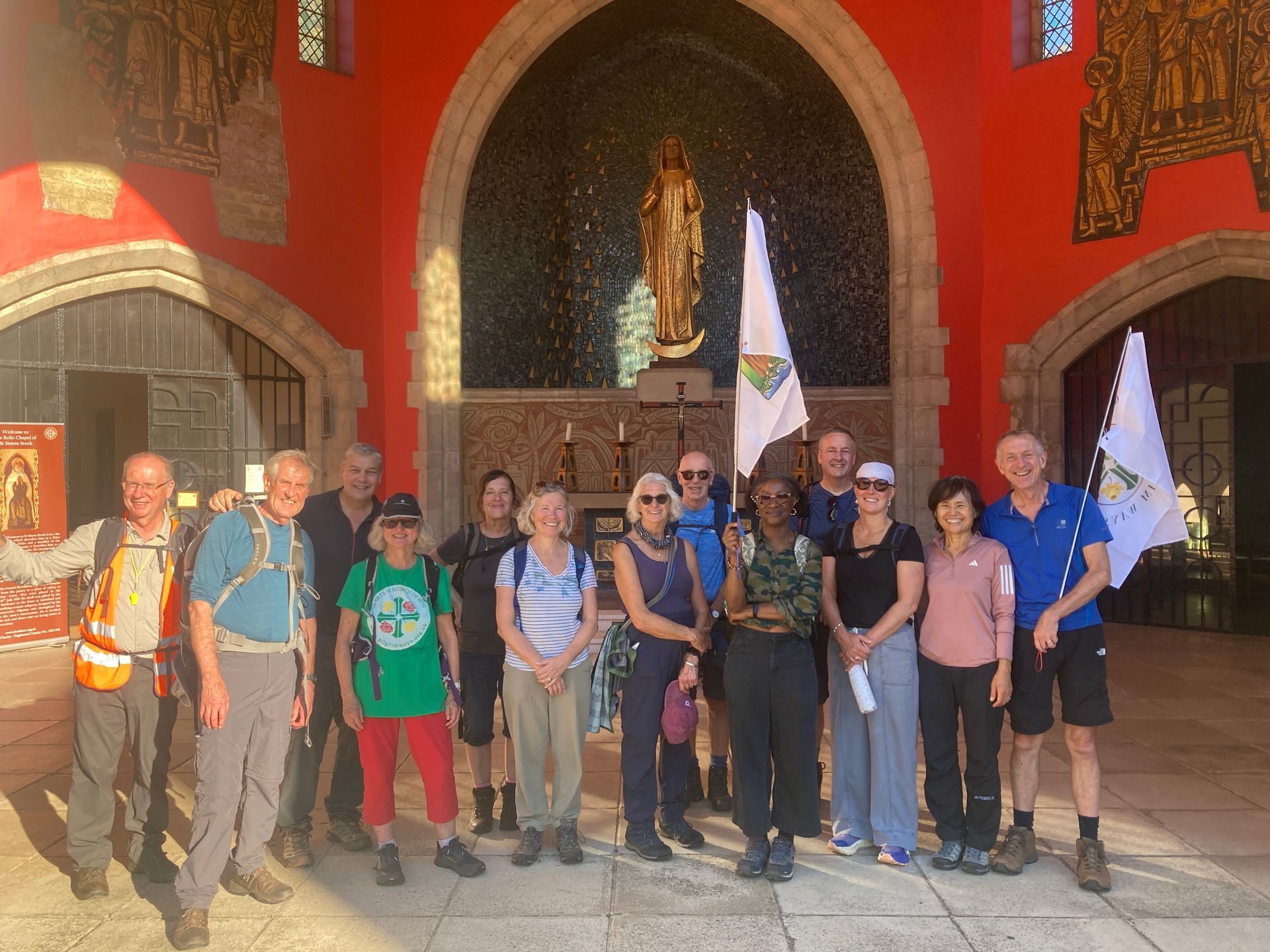
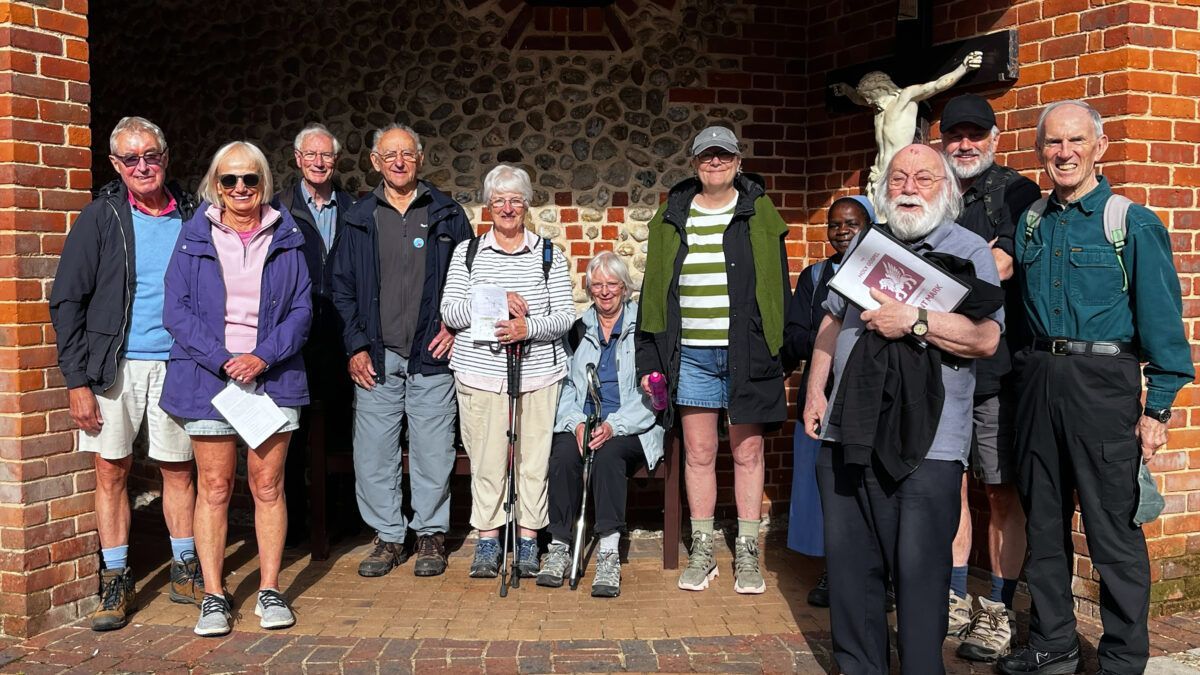
To my surprise and delight, the final stage to Canterbury turned into something of an event. A dozen friends joined Stella and me on the path, and still more were waiting to meet us in Canterbury. It was joyful, but also strange to be suddenly sharing the path with so many; and this effect was only amplified when, just a few miles short of Canterbury, in Chartham, we chanced upon an enormous gathering of pilgrims. There were more than five hundred of them, all having set off from Rochester, and were pausing for rest before the final push to Canterbury. A couple of priests were involved in a kickabout on the green.
They set out just ahead of us, chanting as they walked, and it took us half an hour to overtake them. I recalled the winter walks with Stella along the Britannica, when the path was mostly deserted, and when I remained unconvinced that we would ever reach Canterbury. Yet here we were, almost unable to move for pilgrims. In this, the first official year of the Britannica’s life, it seemed a very good omen. At the Cathedral, Stella and I both received our final pilgrim stamps and a pair of certificates for completing the Britannica. Stella enjoyed chewing on her complimentary bookmark, and I enjoyed sinking a few beers in The Old Buttermarket.
It’s been heartening and inspiring to watch the Britannica’s development of late. The recognition by the EAVF came just four-and-a-half months after Stella was born, and both seem to have grown at a similar rate. It’s been wonderful hearing the stories from pilgrims who have been walking the path this year. Nearly 600 photos of the route have been uploaded by walkers to the Komoot app. The path is well and truly alive.
This year’s journey with Stella along the Britannica is one I’ll long cherish. To a large extent, I got to watch her grow up along the path, each walk offering a little window in time through which I could measure how she was changing. I remember well that tiny wriggling girl who I set out with from Southwark. By the time we reached Canterbury, I could hold on to her shoulders while she trod some speculative steps of her own.
Alex Knox lives in London and is a trustee of Pilgrims to Rome. Stella is the youngest member.