What is a Religious Journey?
Journeys feature extensively in religious literature and art but they are not all understood in the same way. In this article Fleur Dorrell considers what makes a journey religious and how this is manifested.
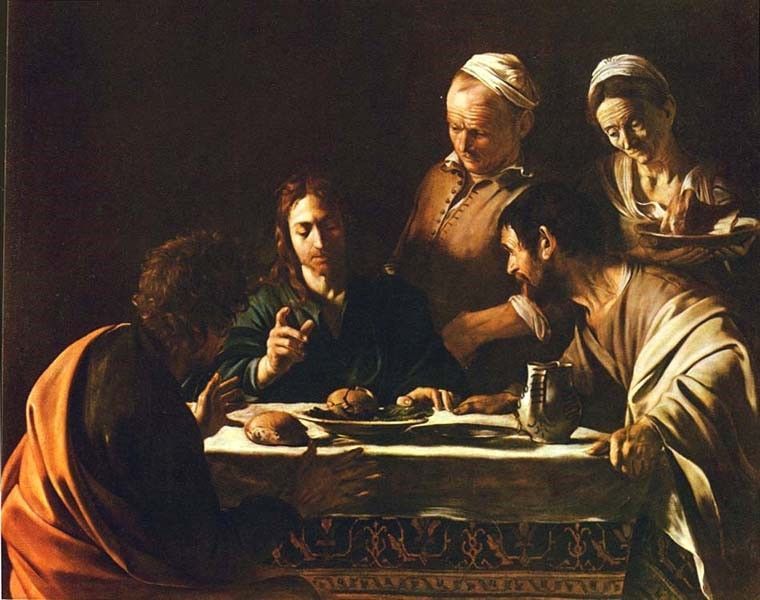
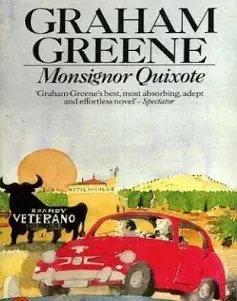
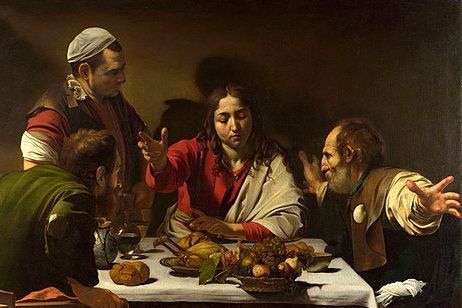
She explores how symbolism and revelation are crucial elements of this and how they illuminate the traveller’s path. She focuses on the Gospel of St. Luke’s story of the Road to Emmaus; Caravaggio’s two paintings of the Supper at Emmaus and Graham Greene’s novel Monsignor Quixote. Although these represent three different media, she shows how they are united in their use of the journey metaphor.
Fleur Dorrell is the Catholic Scripture Engagement Manager for the Catholic Bishops’ Conference and Bible Society. She is the national co-ordinator of the God who Speaks initiative. This article is based on her MA dissertation.

Setting Off
Journeys feature extensively in religious literature and art but they are not all understood in the same way. Therefore I want to look at the religious journey which is not simply any process of change (too vague) or a pilgrimage (too specific) but is nevertheless of spiritual significance. I want to consider what makes a journey religious and how this is manifested. I will show this by exploring how symbolism and revelation are crucial elements of this expression and how they illuminate the traveller’s path.
I have chosen the Gospel of St. Luke’s story of the Road to Emmaus; Caravaggio’s two paintings of the Supper at Emmaus and Graham Greene’s novel Monsignor Quixote because first, only in Luke’s Gospel does the Emmaus story appear. Second, it is through the use of symbol and revelation within the serendipitous journey that the climax occurs, which third, provides Caravaggio with a rich narrative palette from which to interpret the biblical text visually; and a journey of Caravaggio’s own between painting the picture twice over five years. Fourth, Greene’s novel also contains several journeys that form the basis of the central plot, and a similar climax is reached at the end of his characters’ adventures through dramatic symbolism and revelation. Thus in presenting a gospel, fine art and a novel in three different periods of history and culture, I will demonstrate how their creators and their techniques, despite using different media, can nevertheless be united in showing their use of the journey metaphor.
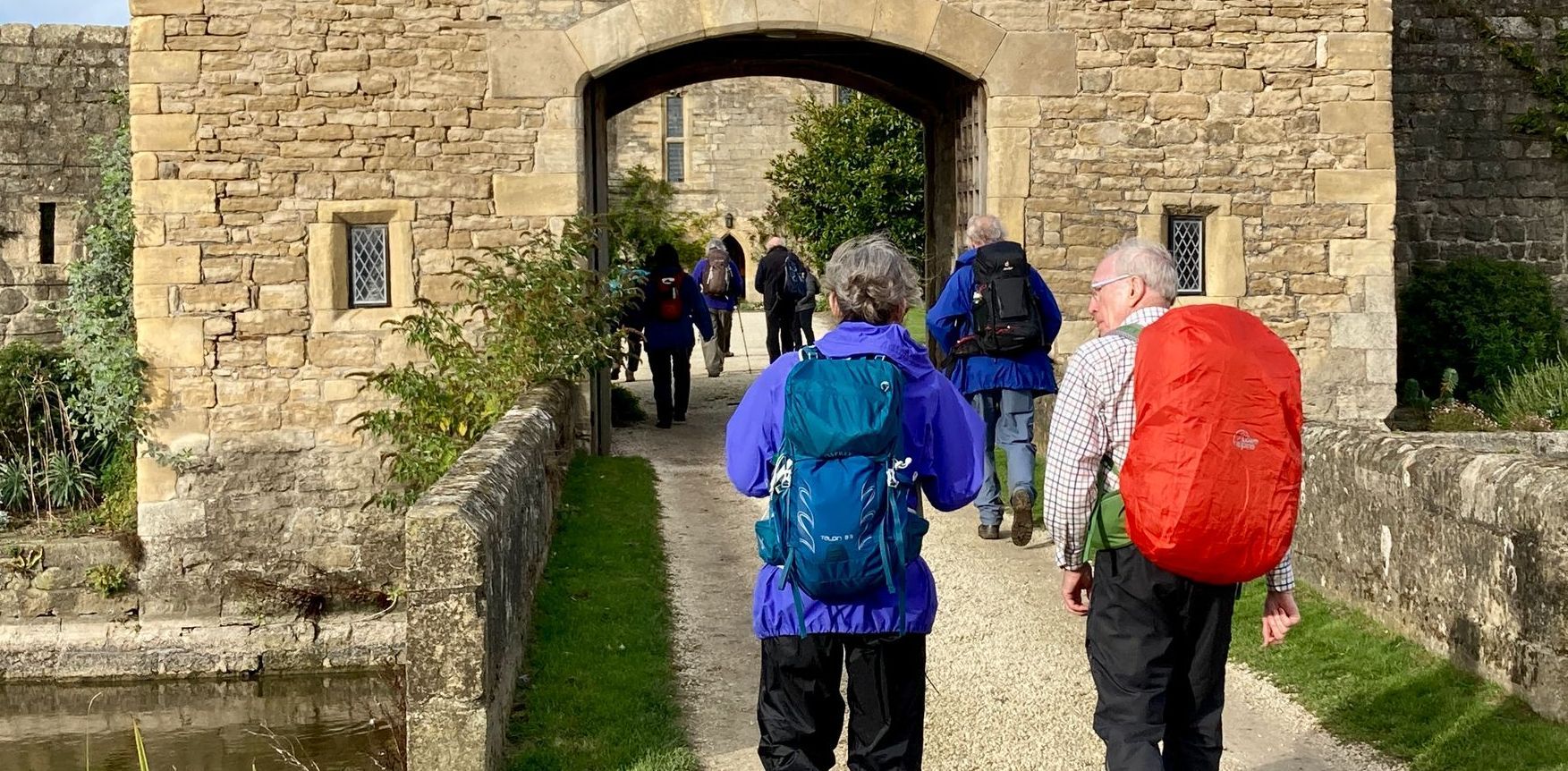
I argue that a religious journey is not the same as a pilgrimage. Pilgrimages are dedicated journeys to specific holy shrines with the purpose of engaging with one’s faith; undertaken when the individual is seeking enlightenment and spiritual renewal. Wherever and whatever the length of the pilgrimage, a key component is the openness to interior change. Religious journeys however, need not be so focused, and the destination may be less important. In the New Testament the idea of pilgrimage is virtually non-existent despite several sacred places being mentioned. Pilgrimages became popular from the fourth century A.D. through the encouragement of writers such as St. Jerome; although he cautioned the believer that their faith in one place was just as acceptable to God as in another “though you have not seen Jerusalem. While pilgrimages are central to all the world’s major faiths, according to Ian Bradley, Christian pilgrimage reached its zenith in the Middle Ages with thousands of people travelling mainly to Rome, Santiago de Compostela and St Andrews.
The journey to Emmaus that the two disciples make, one called Cleopas while the other is unnamed, begins, so far as we know, as neither a pilgrimage nor specifically a religious journey although it becomes holy as soon as the ‘stranger’ joins them. The destination becomes both a journey towards Emmaus and a passage towards realised faith in Jesus Christ as the Son of God. The latter occurs through a unique symbolic gesture that physically and ‘spiritually’ reveals Christ to the disciples just before they begin to eat their supper. Caravaggio’s two paintings of this story do not focus on the travelling motif. Rather, he provides two slightly different interpretations of the story as the culmination of a journey which becomes religious through the use of dramatic symbolism and revelation. Not only does Caravaggio create a representation of the key moment in Luke’s story but because he paints it twice, Caravaggio presents the viewer with a further journey of his own in the years between. I contend Norman Sherry’s view that Greene’s novel Monsignor Quixote is “also a theological and political pilgrimage...” because the journey on which Quixote and Sancho embark begins as a holiday. However, the two friends’ travelling becomes religious as their adventures unfold and the journey too reaches its climax with a celebration of the Eucharist.
Throughout this dissertation I will explore how the journey metaphor can be read as religiously significant and shaped through the vehicles of symbolism and revelation. What is it that is being revealed through symbolic imagery and language? What is the significance of the travellers’ participation? Can we distinguish between deliberate, artificially implanted symbolism and that which is intrinsically present or latent? Let us begin by defining symbol and revelation.
Signposts: Symbol and revelation
‘Symbol’ derives from the Greek word σύμβολον (symbolon) meaning a ‘token’ and originates from Homer’s use of the idea of throwing two things together and creating something new. Revelation is revelatio from revelare in Latin and ἀποκάλυψις (apokalypsis) in Greek. It is the act of revealing something obvious in part or in full, through communication that is most commonly with supernatural beings. Revelation originates directly from a deity or through an agent such as an angel or prophet. The Christian faith is dependent on the divine revelation of God incarnate in the flesh of Christ. Unlike the Homeric example, a Christian object, place or person can symbolise the sacred while remaining exactly as it is.
In Paul Tillich’s book Dynamics of Faith he claims that symbols have six characteristics of which four are relevant to this study: they point beyond themselves to something else; they participate in that to which they point; they open up levels of reality which are otherwise closed for us; and they unlock dimensions and elements of our soul which correspond to the dimensions and elements of reality. I disagree with Tillich’s two remaining characteristics of a symbol: that they cannot be produced intentionally or invented since we will see that Luke, Caravaggio and Greene all created and manipulated symbols precisely to reveal a further meaning. To comprehend a symbol requires participation in the reality of what it represents and reveals, as well as the ability to abstract the essence of the symbol from all its other elements and context. As all symbols point to something beyond their physical form, the way in which their form is revealed tells us much about what they are transcending.
Symbols are central to humanity because they help to make sense of the world and create connections between the ordinary and the transcendent, the particular and the universal, the present moment and eternity. They create bridges between the past, present and future. They reveal and conceal in equal measure. They push forwards and against their own meaning creating a tension of opposites that is not held in equilibrium since the symbol always points to something more. Symbolism is the making of a truth present where it would otherwise be absent. In symbolism mimesis (representation) leads to methexis (participation). Symbols participate in the reality of that which they symbolise. In recapturing the perception that the ancient world had of symbols, writers and artists make present the realities they signify. I have chosen Luke, Caravaggio and Greene because they were able to convey what certain symbols signified in such a way as to make manifest the Biblical God and his incarnation. They also showed how to depict the Judaeo-Christian fellowship meal (which later came to be the sacrament of the Eucharist) in the context of the journey metaphor.
Paul Avis argues that Christian theology implies a spiritual interpretation of the material world so that the material world is understood as an insufficient definition of the world’s purpose and meaning. Christian theology points to a transcendent creativity as the essence of the universe. The sacraments are there to make God’s presence real to the material world in the absence of God incarnate as Jesus the man. In receiving the Eucharist, Christians receive Christ because that symbol represents him. This does not mean that the sacramental view of symbols needs to be specifically Christian but it does imply that within the Christian faith there is a particular purpose and way in which symbols are manifested and understood. For Christian apologists, such as Origen and Augustine, symbols are charged with complex meanings and enhance the Christian faith with new insights. These symbols await the fulfilment of their meaning in the actualisation and recognition of them although never totally in this life. The waiting for fulfilment is partially dependent on time, and time is intrinsic to the spiritual significance of a religious journey.
Time turns into a pleroma, that is, a totality of divine powers, by the fact of Christ’s incarnation, and then transfigures itself – the time that saw Jesus live, be crucified and resurrected. Thus time is ontologised; time is made to be, which means that it ceases to become, time transforms itself into eternity. There is a cosmic story being played out against a linear Newtonian concept of time. The instant that is transfigured is the revelation. The Divine is concealed in history since Jesus of Nazareth is not outwardly distinguished from his Palestinian contemporaries either visually or in behaviour. Yet he becomes the total theophany. After the incarnation and death of Christ, miracles are not easy to recognise, the mysterious becomes more complex and therefore, the symbols and what they reveal, become more necessary.
In western storytelling and art, the concept of time is as much a mystery as it is a revelation: the author, the artist, the reader and the viewer have all to confront it. It is a recurrent measurement of movement and the location of a focal point. Luke’s understanding of time is described in two ways, as he relates to past Israelite history and as he promises the Kingdom of God through the journey and mission of Christ. Caravaggio achieves a suspension of time in motion through the focus of one act that has consequences beyond his paintings’ canvases, and the visual and the invisible moments are brought together. Caravaggio’s visual insights and techniques prove in a different medium from the written word, that vision is greater than speech can show. Greene learned much from Cervantes in his use of time in Monsignor Quixote. Texture, mood, landscape, dialogue and gesture are all described with perfect ease. Greene held the tension between time and motion in balance so that the final action takes place where time is not of human creation, but of God’s doing. With all three of my protagonists we notice a further element in our concept of time, the difference between telling and showing.